
Your Life’s Toolkit: The Wisdom You Forgot You Had
by Jim Smith

How to recognize the wisdom you forgot you had
Have you ever noticed that the lessons that changed your life often become the ones you think are too ordinary to mention?
That happens because wisdom has a strange habit. Once we’ve learned something well, we stop noticing it. What once took years of trial and error becomes second nature. We assume everyone else already knows it too.
Most of the time, they don’t.
In an age where artificial intelligence can answer almost any question, many people wonder whether their own knowledge still has value. The answer is yes, but perhaps not for the reason you think.
Information is everywhere. Wisdom is still remarkably rare.
Why wisdom matters more than information
Information explains how something works.
Wisdom explains why it matters.
Artificial intelligence can summarize a book in seconds. It can list the steps to start a business, move abroad, change careers, or learn a new skill.
What it cannot do is replace the judgment that comes from living through uncertainty, making mistakes, adapting, and finding a better way.
That is the difference between knowledge and wisdom.
Knowledge can be collected.
Wisdom must be earned.
Your toolkit has been growing for years
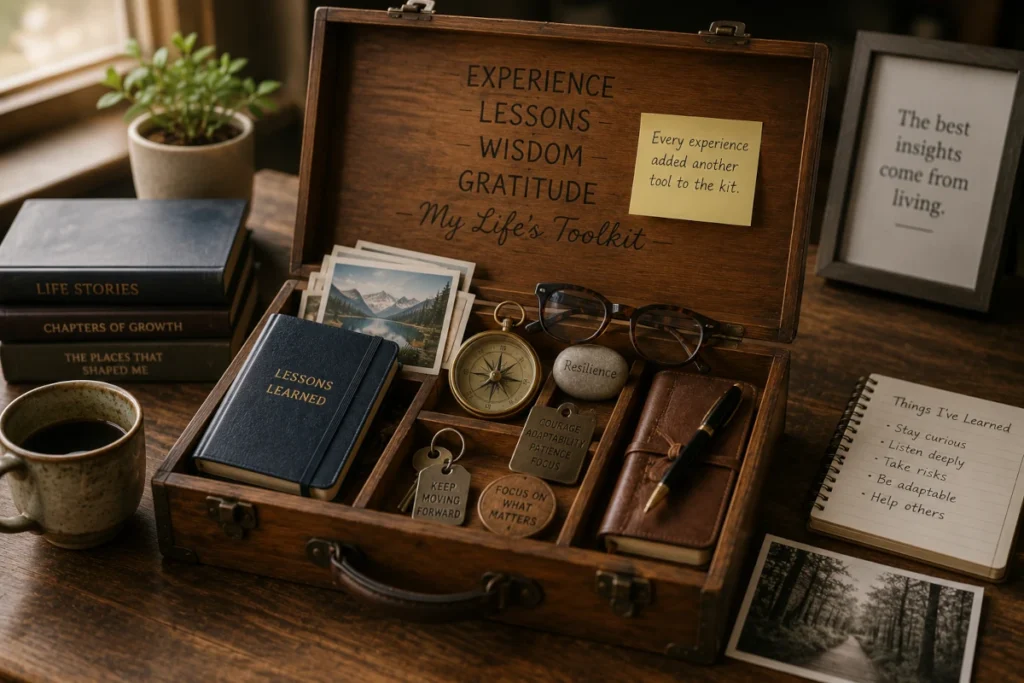
Think about your own life for a moment.
Every difficult project.
And unexpected career change.
A relocation.
Each relationship.
Every success.
Every disappointment.
Each one quietly added another tool to your personal toolkit.
You probably don’t think of those experiences that way because you’ve been carrying them for so long. Yet together they form something no one else possesses: your unique way of seeing problems, making decisions, and helping others.
That toolkit is one of your greatest assets.
The lessons you overlook are often the most valuable

People rarely ask what they’re uniquely qualified to share.
Instead, they ask whether they’re enough of an expert.
It’s the wrong question.
A better question is this:
What have I learned that someone else is just beginning to experience?
Perhaps you’ve learned how to rebuild after a layoff.
Maybe you’ve navigated retirement, started a small business, cared for aging parents, relocated to another country, adapted to new technology, or recovered from a difficult setback.
Those lessons may feel ordinary because they’re now part of your daily thinking.
To someone standing where you once stood, they can be life-changing.
Wisdom creates connection
Facts may attract attention.
Stories create trust.
When you share something you’ve genuinely lived through, people recognize the difference immediately.
You’re no longer repeating advice.
You’re offering perspective.
That perspective helps people make better decisions because it comes with context, nuance, and empathy.
It reminds them that someone else has walked a similar path.
Your next chapter may begin by helping someone else’s
Many people believe they need another certification, another course, or another credential before they have something worth sharing.
Often, what they need instead is to recognize the value of what they already know.
Your life’s toolkit wasn’t built overnight.
It was assembled one experience at a time.
Those experiences can become articles, conversations, mentoring, consulting, videos, workshops, or simply encouragement for someone facing a challenge you’ve already overcome.
You don’t need to know everything.
You only need to know a little more than the person you’re helping today.
A simple exercise
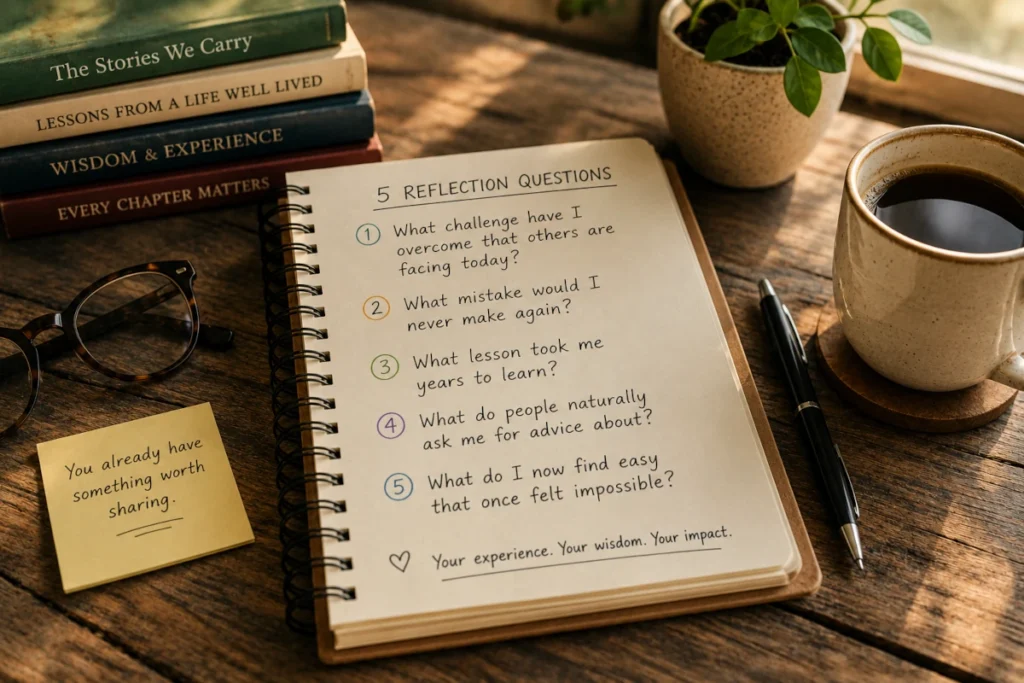
Take out a notebook and answer these five questions.
- What challenge have I overcome that others are facing today?
- What mistake would I never make again?
- What lesson took me years to learn?
- What do people naturally ask me for advice about?
- What do I now find easy that once felt impossible?
Don’t overthink your answers.
You’re not creating a résumé.
You’re uncovering your wisdom.
Your wisdom deserves to be shared
The internet has no shortage of information.
What people are searching for is understanding.
Someone, somewhere, is facing a problem you’ve already solved.
They’re asking a question you’ve already answered through experience.
And are hoping to hear from a person who has walked the path ahead of them.
That person could be you.
The greatest contribution many of us will ever make is not discovering something entirely new. It is sharing what life has already taught us so that someone else’s journey becomes a little shorter, a little clearer, and a little less lonely.