
Experience Still Matters in the Age of AI After 50
Author J. Smith
Why are many experienced adults feeling invisible in today’s economy?
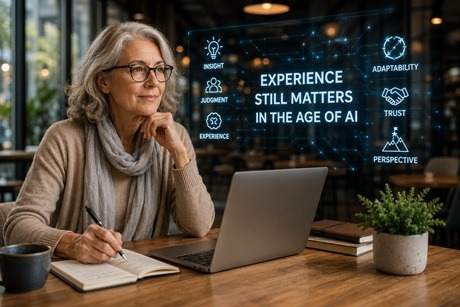
Experience still matters in the age of AI, even though many professionals over 50 are beginning to question their value in the modern workplace.
The economy is changing quickly. Artificial intelligence is transforming many forms of white-collar work. Remote marketplaces are crowded with younger workers who grew up with digital tools and automation.
As a result, many experienced adults feel uncertain about where they fit.
Former executives, consultants, teachers, marketers, writers, and small business owners are asking difficult questions. They wonder whether their skills still matter. Some fear they are too late to adapt to the new digital economy.
Those concerns are understandable. However, they also miss an important shift happening beneath the surface.
Research from Pew Research Center continues to show that technology adoption among older adults has grown significantly over the past decade. That trend challenges the outdated assumption that experienced professionals cannot adapt to digital change.
What does AI still struggle to replace?

Experience still matters in the age of AI because technology still struggles with human judgment.
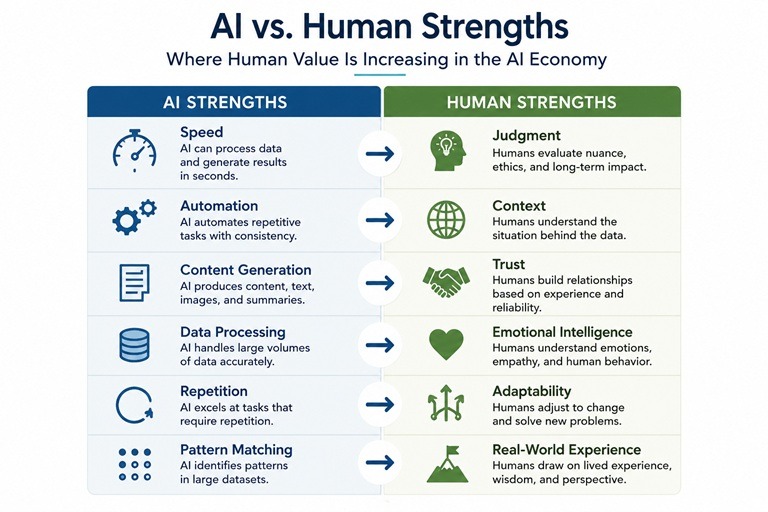
AI can process information quickly. It can summarize data, generate content, and automate repetitive tasks. Yet businesses still depend heavily on people who understand context, emotion, and human behavior.
That difference is becoming increasingly important.
Experienced professionals often recognize patterns that software cannot fully interpret. They understand customer behavior, communication problems, and organizational tension in ways that come from years of observation.
Many clients and companies are also becoming overwhelmed by synthetic communication and AI-generated content. As more automated material floods the internet, trust becomes more valuable.
According to Gartner, executives across multiple industries continue to rank AI adoption and workforce transformation among their highest strategic priorities. At the same time, organizations are struggling to balance automation with human-centered leadership and communication.
Human qualities such as judgment, adaptability, emotional intelligence, and perspective are becoming stronger differentiators.
Why does personal branding feel uncomfortable after 50?

Many adults over 50 associate personal branding with self-promotion and influencer culture.
That perception causes many experienced professionals to avoid building any digital visibility at all.
In reality, personal branding is much simpler.
It means making your experience understandable to the right audience.
That visibility can take many forms:
- Thoughtful articles
- LinkedIn professional commentary
- Educational videos
- Niche consulting
- Podcast interviews
- Community leadership
- Small online groups
- Specialized newsletters
You do not need millions of followers.
You also do not need to turn your life into a public performance.
Many audiences are now looking for calmer and more credible voices because online spaces are becoming increasingly noisy and artificial.
Why are mature professionals quietly gaining an advantage?
Experience still matters in the age of AI because automation is changing what people value online.
For years, digital visibility rewarded speed and constant activity. AI is now making those qualities easier to duplicate.
As content generation becomes automated, audiences are paying more attention to substance and credibility.
That shift creates opportunities for experienced professionals.
People with decades of real-world experience often communicate with greater clarity and emotional balance. They also understand long-term consequences better than many younger workers who are still early in their careers.
Industries such as consulting, healthcare, education, hospitality, customer experience, and relocation services still depend heavily on trust and communication.
Recent World Economic Forum Future of Jobs reports suggest that communication, analytical thinking, adaptability, and resilience are becoming increasingly valuable in the modern workforce alongside technical abilities.
Those fields continue to reward human understanding.
What is a faceless brand?
A faceless brand focuses on value instead of personality performance.
Many experienced adults want visibility without becoming social media influencers. They prefer privacy and professionalism over constant exposure.
That approach is becoming more effective again.
You can build a respected online presence around:
- Expertise
- Observation
- Teaching
- Problem-solving
- Industry insight
- Practical guidance
- Life experience
This type of branding feels more natural for many professionals over 50 because it emphasizes usefulness instead of attention-seeking behavior.
How should experienced adults respond to AI?
The wrong strategy is trying to compete directly with younger technical specialists.
A better strategy combines technology awareness with human experience.
That means learning enough AI to remain relevant while continuing to strengthen the skills that machines cannot easily replace.
Remote and hybrid work trends are also reshaping professional opportunities for experienced adults. Data from FlexJobs Remote Work Statistics shows that remote work continues to expand across many industries, creating new possibilities for consultants, educators, writers, advisors, and independent professionals.
The future economy will reward people who combine:
- Human understanding
- Communication skills
- Adaptability
- Emotional intelligence
- Professional experience
- Technology awareness
That combination is becoming surprisingly rare.
Conclusion
Experience still matters in the age of AI because human judgment is becoming more valuable as automation expands.
Many professionals over 50 assume technology has made their experience irrelevant. In reality, the opposite may be happening.
As AI-generated content increases, trust becomes more important.
As automation spreads, people notice emotional intelligence and perspective more clearly.
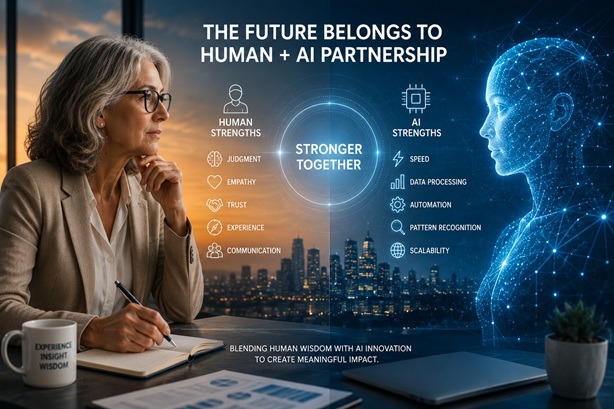
The future does not belong entirely to machines or to younger technical workers. It belongs to people who can combine experience, adaptability, and technology in practical ways.
That creates real opportunities for experienced adults willing to reposition themselves instead of disappearing from the conversation.